

Description De La Peinture De Norman Rockwelle Rosie
Test your knowledge with a quiz
Rockwell, Rosie the Riveter
Congratulations - you have completed Rockwell, Rosie the Riveter. You scored %%SCORE%% out of %%TOTAL%%. Your performance has been rated as %%RATING%%
Your answers are highlighted below.
There are 4 questions to complete.
You have completed
questions
question
Your score is
Correct
Wrong
Partial-Credit
You have not finished your quiz. If you leave this page, your progress will be lost.
Correct Answer
You Selected
Not Attempted
Final Score on Quiz
Attempted Questions Correct
Attempted Questions Wrong
Questions Not Attempted
Total Questions on Quiz
Question Details
Results
Date
Score
Hint
Time allowed
minutes
seconds
Time used
Answer Choice(s) Selected
Question Text
All done
Need more practice!
Keep trying!
Not bad!
Good work!
Perfect!
Key points
- America's entry into WWII created a demand for women's labor as the defense industry grew and men enlisted in the military. Women were encouraged to join the workforce as a patriotic service to their country. They also spearheaded support organizations and fundraising groups that supported the war effort.
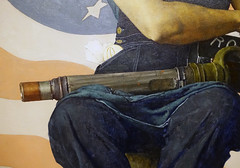
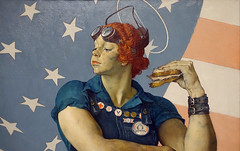
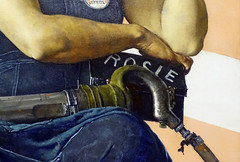
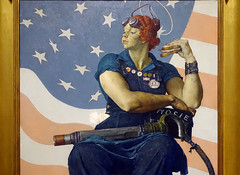
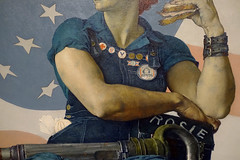
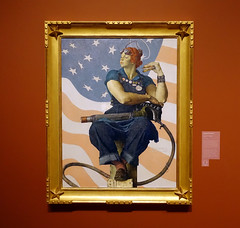
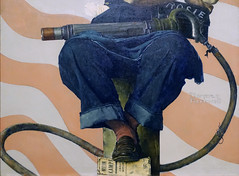
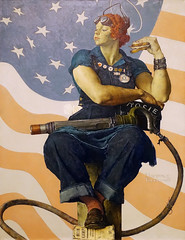
- Rosie the Riveter was an idealized mascot for women workers. First coined in a 1942 song, her identity came to represent the newly empowered woman. In Norman Rockwell's depiction, she combines femininity with a commanding muscularity. Rosie wears men's work clothes and holds a riveter in her lap as she pauses from her work to eat lunch.
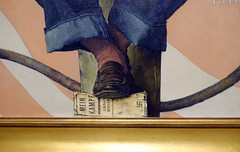
- Norman Rockwell's painting of Rosie the Riveter includes biblical and symbolic references that elevate the subject. The body and pose are copied from Michelangelo's painting of the prophet Isaiah from the Sistine Chapel. This is amplified by the snake-like form of the riveter, which suggests a reference to a righteous serpent that slayed an evil monster from the book of Isaiah (especially as Rosie crushes a copy of Adolf Hitler's Mein Kampf under her foot). She also evokes traditional depictions of the Madonna and Child.
- Tensions arose as men returned home from war and re-entered the workforce. Women were not universally willing to relinquish their newfound freedom and independence. This started new debates on the role of women, especially in the workplace, in the modern era.
Go deeper
See this object at the Crystal Bridges Museum of American Art
Learn more about this image as the cover of the Saturday Evening Post
Explore some records , images , video, and other primary sources about women working on the homefront during WWII
Read more about the contributions of women during WWII
Learn about the evolution of the figure of Rosie the Riveter
Listen to the original song about Rosie the Riveter from 1942
Read about what happened to women in the workforce as men returned home from the war
More to think about
Which details of this painting challenge female stereotypes, and which seem to reinforce traditional expectations of gender? Discuss contemporary attitudes about women in the workforce. Does Rockwell's painting still seems relevant in the message it presents about gender?
Smarthistory images for teaching and learning:
More Smarthistory images…

Description De La Peinture De Norman Rockwelle Rosie
Source: https://smarthistory.org/seeing-america-2/norman-rockwell-rosie-the-riveter-sa/
Posted by: ashleylicess.blogspot.com
0 Response to "Description De La Peinture De Norman Rockwelle Rosie"
Post a Comment